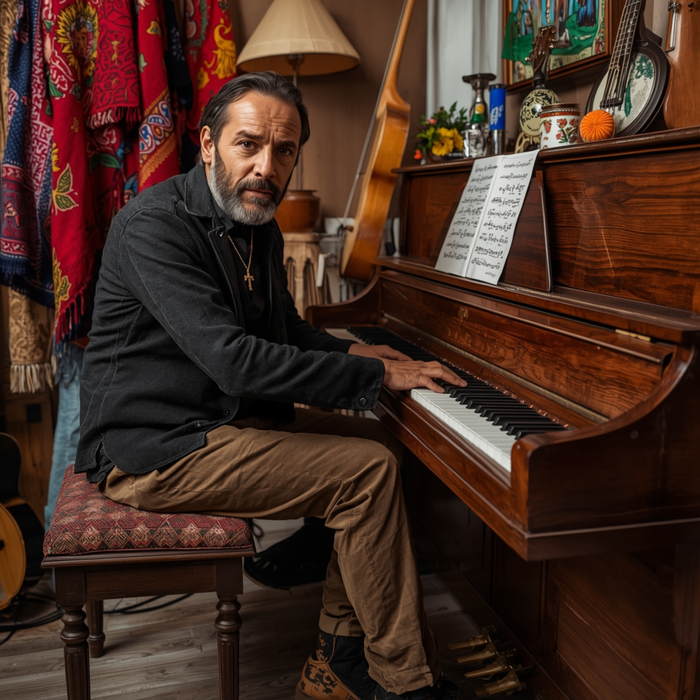
Terres Lointaines Op. II

Terres Lointaines Op. II

Personal License
$24.00
30-second preview ended
Like what you heard?
Terres Lointaines Op. II
30s Preview
· Instrumental · No Vocals
Terres Lointaines Op. II
0:00 Preview · 0:30
$24.00 2 versions · MP3 · License incl.
Skip to product information
Terres Lointaines Op. II

Terres Lointaines Op. II

$24.00
License Type
How This Piece Came to Life

The question that generated this piece was honest and slightly arrogant: what would a pianist sound like if they spent their entire life traveling, and every country they visited left something permanent inside their hands? Not a pastiche. Not a medley. Not world music sampled and repackaged. What would the hands of someone who had genuinely studied — slowly, humbly, over years — in five different musical traditions actually play when they sat down alone at a piano?

The answer required research into five distinct traditions, not as tourist but as student. Japanese ma — the concept of meaningful silence, negative space as the primary material of art — is not a style choice. It is a philosophy that requires the performer to trust silence the way a Western musician trusts sound. West African kora playing — the flowing, cross-rhythmic 3-against-4 polyrhythm of the Mandinka griot tradition — is not an ornament. It is a fundamentally different relationship to the beat, one that makes Western 4/4 feel like a simplification. Flamenco's duende — the untranslatable Spanish concept of the dark, possessed quality that separates a great flamenco performance from a merely good one — cannot be imitated. It can only be earned through emotional truth. The American blues and Rachmaninoff sit together in this piece because they are, in the deepest sense, the same tradition: music that converts personal suffering into collective catharsis at maximum emotional volume. And French Impressionism — the tradition of Debussy and Ravel — is the tradition of finding beauty in the return, of making resolution feel like arrival rather than conclusion.

Each of these five traditions was studied seriously before this piece was written. The result is not a piece that sounds like five different pieces stitched together. It is a piece that sounds like one person who has been everywhere and brought it all home.

"Most piano pieces speak one language. This one speaks five — and forgets none of them."

The Meaning Behind It

Terres Lointaines is, at its core, about what travel does to a person who pays attention. Not tourism — travel. The kind where you stay long enough to feel uncomfortable, long enough for the discomfort to become understanding, long enough for the understanding to become love. Every musical tradition in this piece comes from a place and a people with centuries of accumulated wisdom about what music is for. Juxtaposing them is not an act of appropriation. It is an act of listening — the deepest kind, the kind that changes you.

The arc from E minor to G major is the arc of the piece's emotional meaning. E minor is the key of uncertainty, of unresolved longing, of travel itself — you are not home. G major is the key of warmth and arrival. The piece earns its resolution by traveling through every movement that precedes it. The Japanese silence teaches patience. The African rhythm teaches presence. The flamenco passion teaches honesty. The blues and Russian climax teaches courage — the courage to let feeling be as large as it actually is. And the French Impressionist coda teaches the piece — and the listener — how to come home.

There is also something to be said about what happens to identity when you carry multiple traditions simultaneously. Each tradition in this piece is internally coherent — the Japanese movement does not borrow from flamenco; the flamenco movement does not reference Africa. They are kept pure, distinct, fully themselves. The unity of the piece comes not from blending them but from moving through them, the way a person moves through phases of a life. You do not become Japanese or Senegalese or Andalusian. You become someone who has been in all of those places and will never be quite the same.

Solo Piano

♩=54 → 88 → 54

E Minor → G Major

20 Bars · 5 Movements

Op. II · 2026

You may also like